
Heuston
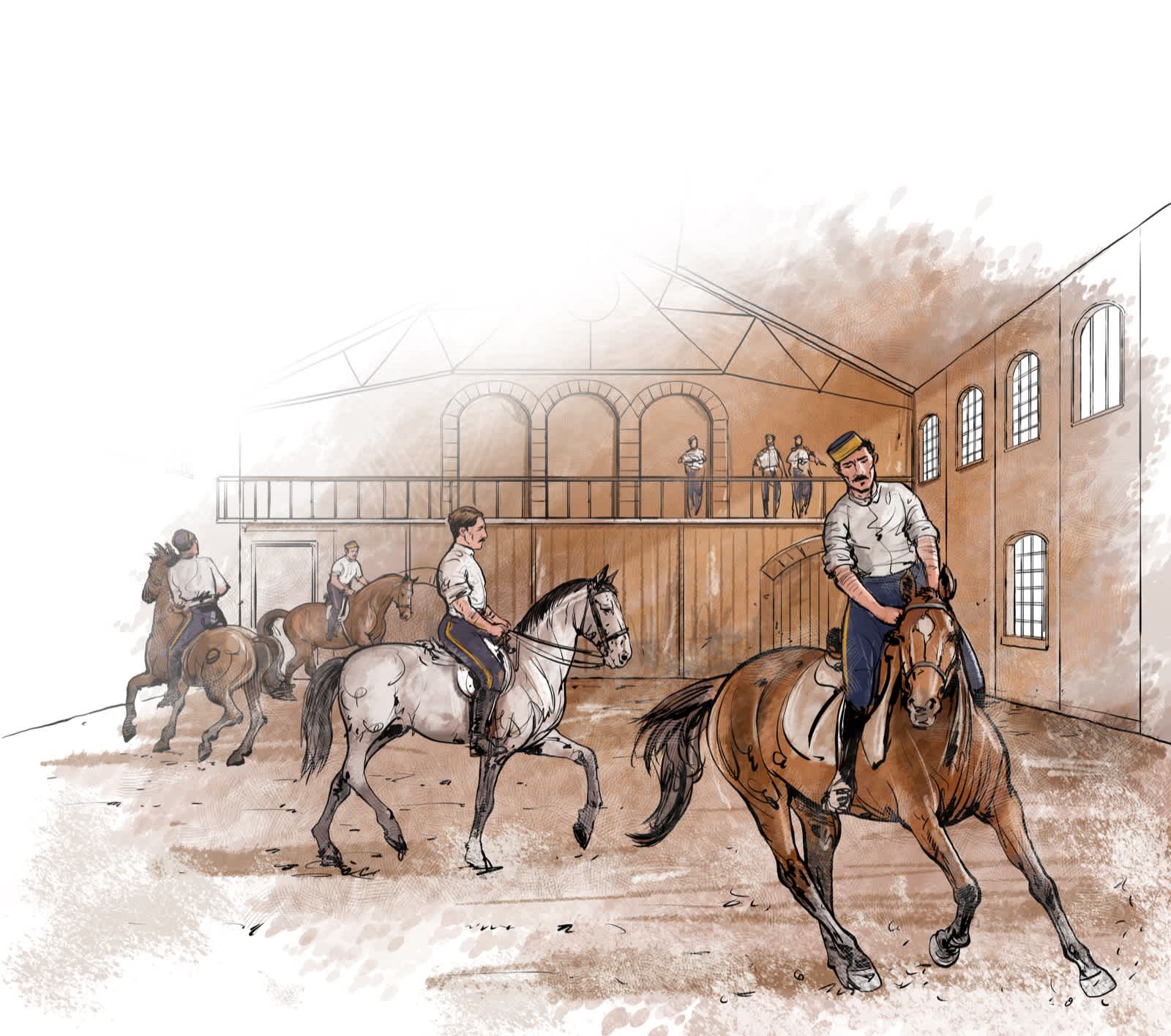
8Built around 1862 as a cavalry riding school, the Heuston building was part of the same redevelopment as the Saddlery, Armoury, Stables and Summer House buildings. The riding school was a large indoor space with a high ceiling, where officers and men would practice manoeuvres on their horses. Good lighting was important and there was a lantern skylight in the pitch of the roof. This was removed in the 1980s, when the building was used as a high-security store by the Irish Defence Forces, but a new one was reinstated in 2009.
While still a riding school, the building was extended at either end. Then, around 1900, after they had stopped stabling cavalry horses at the barracks, a suspended steel and concrete floor was inserted to create two floors and the building was used as a store.
Before the riding school
Up until the late 1850s this area of the site was in private ownership and did not form part of the barracks. It was covered by houses and businesses fronting onto the South Circular Road, with extensive gardens behind them. In the mid-1850s the Board of Ordnance began to acquire more land in order to expand the barracks and make it a major remount depot, a centre where horses for use by the armed services would be brought and then shipped on. In addition, mounted regiments, such as the Dragoons, were posted here. In January 1862 the War Department advertised for tenders for the construction of a Riding School, which was operating by June of the following year.
The riding school
Riding schools have certain standard features, which can be seen in Heuston. A large, high door at either end gave easy access for horses and skylights allowed natural light in, avoiding sudden changes in lighting which can be distressing for horses. The floors are usually covered with sand and woodchips to give a secure footing, with the woodchip requiring raking out and replacing from time to time. Interestingly, the archaeologists working on the site before the present development found a 25cm-deep layer of woodchip in the area around the riding school, presumably the rake-out from the arena surface.
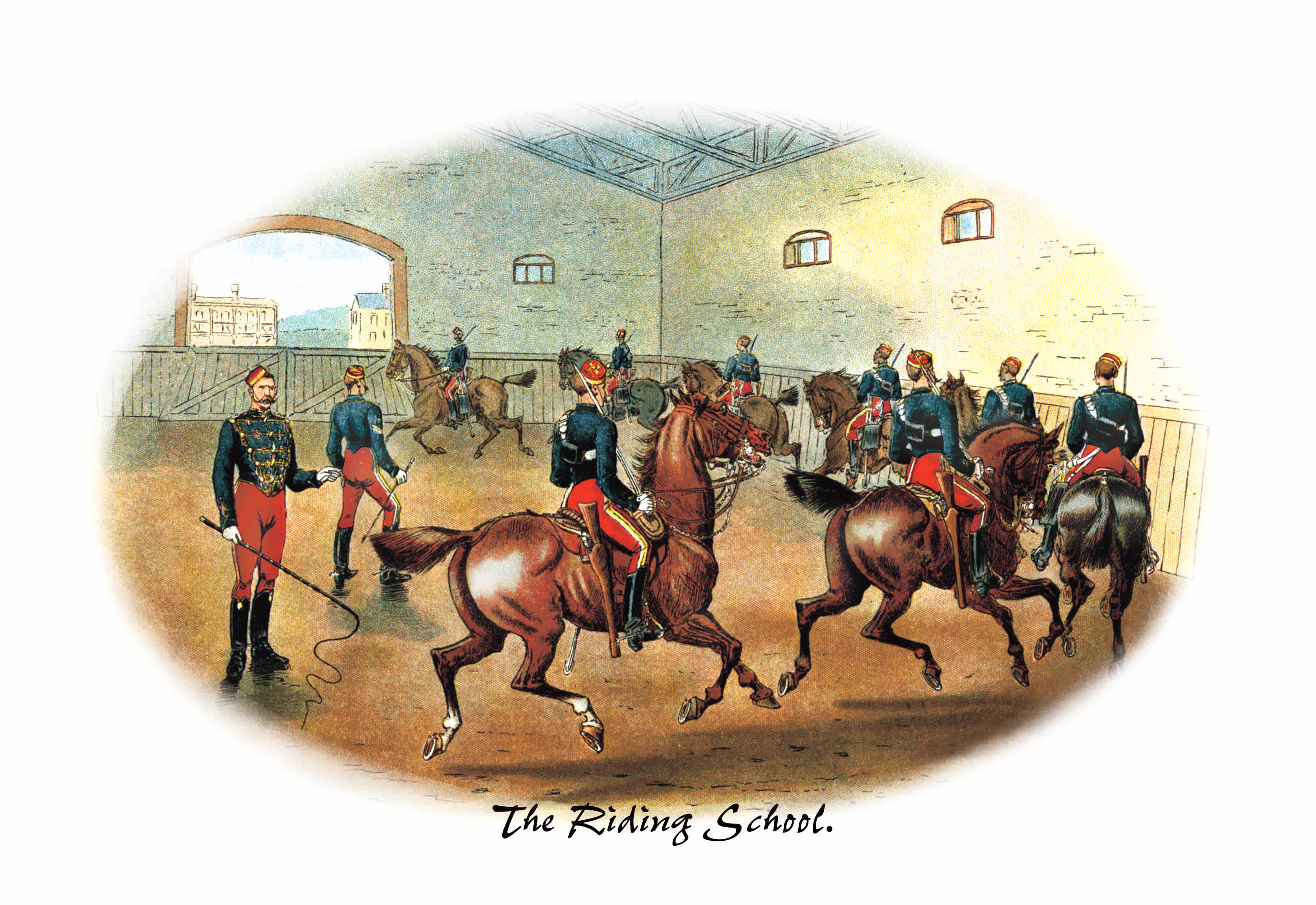
(Richard Simkin/ Alamy Stock Image)
After the riding school
Once the cavalry regiments stopped using the barracks, after a serious outbreak of typhoid there in 1896, the riding school was no longer required. A suspended steel and concrete floor was inserted to create two floors and the building was used as a store. After 1922, when it was transferred to the Irish National Army (later the Defence Forces), it was renamed Group 1 Store. It was used to store all the Defence Forces’ reserves of weapons and as such was one of the most secure buildings in the country. The weapons were stored in hundreds of boxes, all greased and ready for use.

Index >
- Stop 1 > The Officers’ Mess
- Stop 2 > The Schoolhouse
- Stop 3 > Colonnade
- Stop 4 > Peadar Clancy
- Stop 5 > Foley House & Laverty House
- Stop 6 > Tarrant House & Cambridge Sq.
- Stop 7 > Dickie Bird
- Stop 8 > Heuston
- Stop 9 > Cobbles
- Stop 10 > The River Liffey
- Stop 11 > Watch Tower
- Stop 12 > Stables, Saddlery, Armoury & Summerhouse
- Stop 13 > Long Lane Royal