
Cobbles
9Cobbles was built around 1830 on the site of an earlier house. It was originally built as a pair of houses, using brick, limestone and some granite. Each house had a narrow entrance hall and staircase. The houses were used as Commanding Officer’s Quarters. In maps of the 1840s and 1860s they have fine gardens running down to the river. When the Irish Army took over the barracks, the houses were the headquarters of the Ordnance Corps’ commanding officers. During the 1940s or 1950s, they were made into one building with a single staircase.
Waterloo Avenue, leading from the South Circular Road towards Cobbles and on through the barracks site, was named after the British victory over the French at the Battle of Waterloo in 1815.
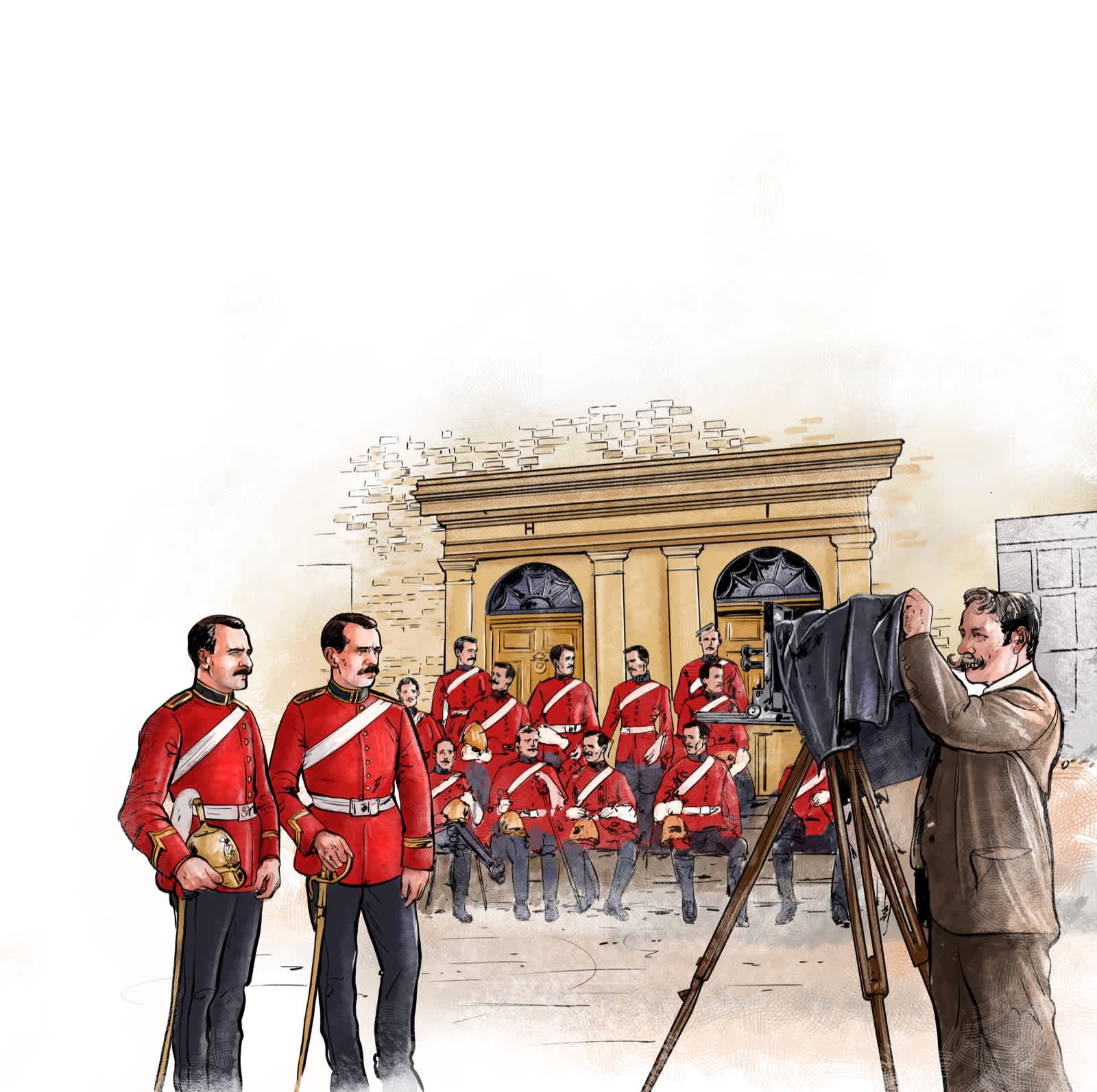
The photograph
The finished photograph is shown below. It depicts the officers of the 1st Royal Dragoon Guards standing before the front doors. The photograph was taken in 1895 by J. Robinson and Sons, Dublin and was published in The Army and Navy Illustrated of 3 January 1896.
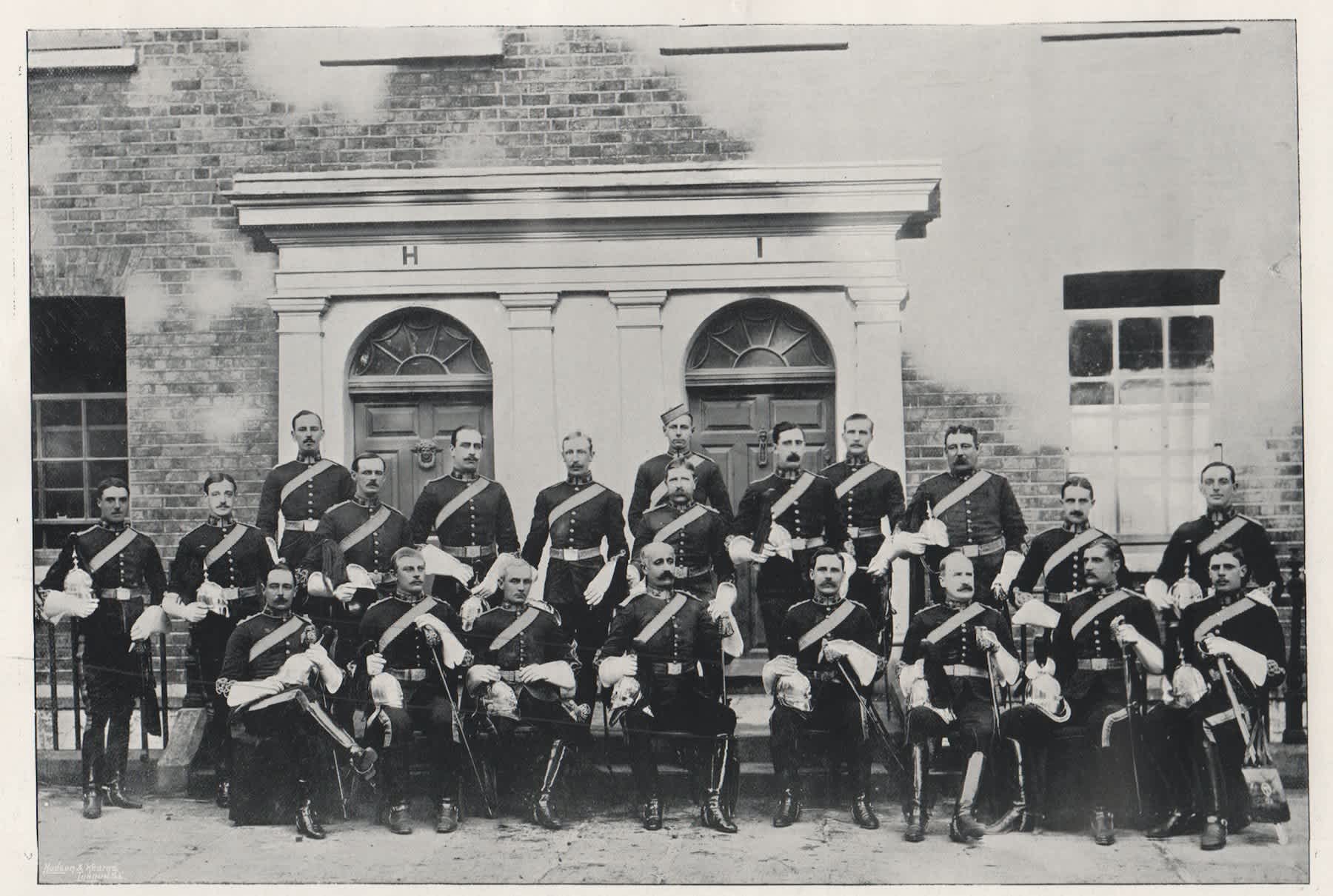
The photographer
James Robinson began as a dealer in scientific instruments and lenses, including opera glasses and magic lanterns at his ‘Polytechnic Museum’ on Grafton Street in the mid-1840s. By the 1850s he was operating as a portrait photographer at 65 Grafton Street, latterly joined by his son James. As well as studio and outdoor photography they also made and sold cameras and photographic equipment. Robinsons also had a London premises at 172 Regent Street, from about 1883.
Robinson advertised that he had two artists who specialised in outdoor photography of subjects, including the military. The Evening Herald of 23 September 1895 noted that Messrs. J. Robinson and Sons had ‘made a name by their splendid outdoor group photographs, which are always excellently executed.’
The building
When the military first took over this site in 1797, a building called ‘The Billiard Room’, was where Cobbles now stands. It is likely that Cobbles was built as two semi-detached houses around 1830 for use in the barracks, although by the 1840s it may have been in civilian use, as was much of the barracks. By the 1860s it was in use as officers’ quarters and a number of its associated outbuildings were demolished to make way for the building of the Riding School (Heuston) to the south.
After the barracks passed to the Irish National Army in 1922, Cobbles became the headquarters of the Ordnance Corps’ commanding officers and remained as such until the barracks closed.
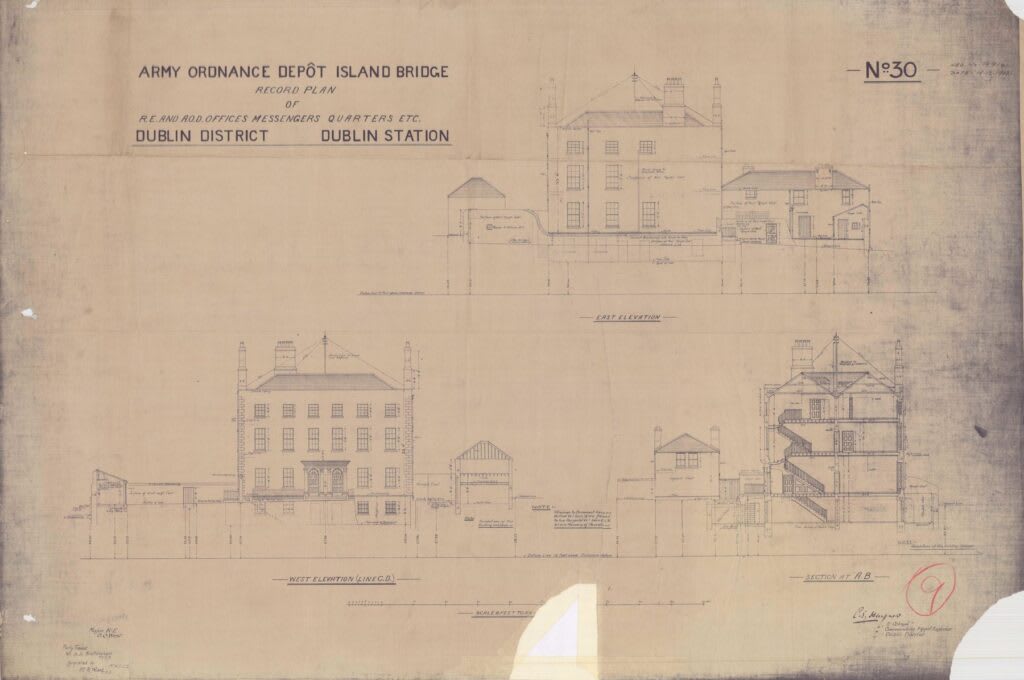
(Military Archives, Ireland: AD119269-010)

Index >
- Stop 1 > The Officers’ Mess
- Stop 2 > The Schoolhouse
- Stop 3 > Colonnade
- Stop 4 > Peadar Clancy
- Stop 5 > Foley House & Laverty House
- Stop 6 > Tarrant House & Cambridge Sq.
- Stop 7 > Dickie Bird
- Stop 8 > Heuston
- Stop 9 > Cobbles
- Stop 10 > The River Liffey
- Stop 11 > Watch Tower
- Stop 12 > Stables, Saddlery, Armoury & Summerhouse
- Stop 13 > Long Lane Royal